Choosing between a menstrual cup and a menstrual disc can feel daunting and it often comes down to personal preference. They're both reusable, both collect your flow rather than absorbing it, both can give you hours of leak-free protection and both can make disposable period products suddenly seem rather high maintenance.
But cups and discs are not the same product in different outfits.
They sit in different parts of the vagina, stay in place differently and can feel completely different once inserted. One person may swear by the secure seal of a menstrual cup, while someone else will put in a menstrual disc and promptly forget they are even having a period.
So, which one is best?
That depends on your anatomy, flow, lifestyle and, as we said, personal preferences. There is no universal winner here. Just two very good options with different talents.
By the end of this guide, you will understand how menstrual cups and discs compare for placement, capacity, comfort, removal, exercise, overnight use, period sex and IUDs - so you can choose the best period product for your body.
Table of Contents
-
What Is the Difference Between a Menstrual Cup and a Disc?
-
Where Does a Menstrual Cup Sit?
-
Where Does a Menstrual Disc Sit?
-
Menstrual Cup vs Disc Capacity
-
Which Is Easier to Remove?
-
What Is Menstrual Disc Auto-Dumping?
-
Can You Use a Menstrual Cup or Disc With an IUD?
-
Menstrual Cups, Discs and Period Sex
-
Exercise, Swimming and Overnight Wear
-
Cost and Environmental Impact
-
Quick Menstrual Cup vs Disc Comparison
-
Which Should You Choose?
-
Frequently Asked Questions
What Is the Difference Between a Menstrual Cup and a Disc?
A menstrual cup is a flexible, bell-shaped product that sits inside the vaginal canal below the cervix. Once it opens, it forms a gentle seal against the vaginal walls and collects menstrual fluid.
A menstrual disc is flatter and wider, with a flexible rim and a collection basin. It is inserted further back, where it sits below the cervix in the vaginal fornix. The front of the disc tucks behind the pubic bone to help hold it in place.
The easiest way to remember the difference is:
A cup sits lower and forms a seal. A disc sits higher and is supported by your anatomy.
Neither product absorbs your flow like a tampon. They collect it, which means they do not create the same dry feeling some people experience with absorbent internal products.
They are less like twins and more like very capable cousins.
Where Does a Menstrual Cup Sit?
Lower in the vaginal canal
A menstrual cup sits inside the vaginal canal, below the cervix. To insert it, you fold the cup, guide it inside and allow it to open.
When positioned correctly, the rim forms a light seal against the vaginal walls. This helps keep your flow inside the cup while you walk, sleep, swim, run or do whatever else your day throws at you.
Because the cup sits lower than a disc, it may feel more accessible when it is time to remove it. For some people, that makes a cup feel less intimidating, particularly when they are new to reusable internal period care.
Others may be more aware of a cup if:
-
They have a particularly low cervix.
-
The cup is too long or firm for their anatomy.
-
It has not opened fully.
-
It is sitting too close to the vaginal entrance.
-
The size or shape is not quite right.
A properly fitted cup should not hurt. In fact, once it is in the right position, you should barely notice it.
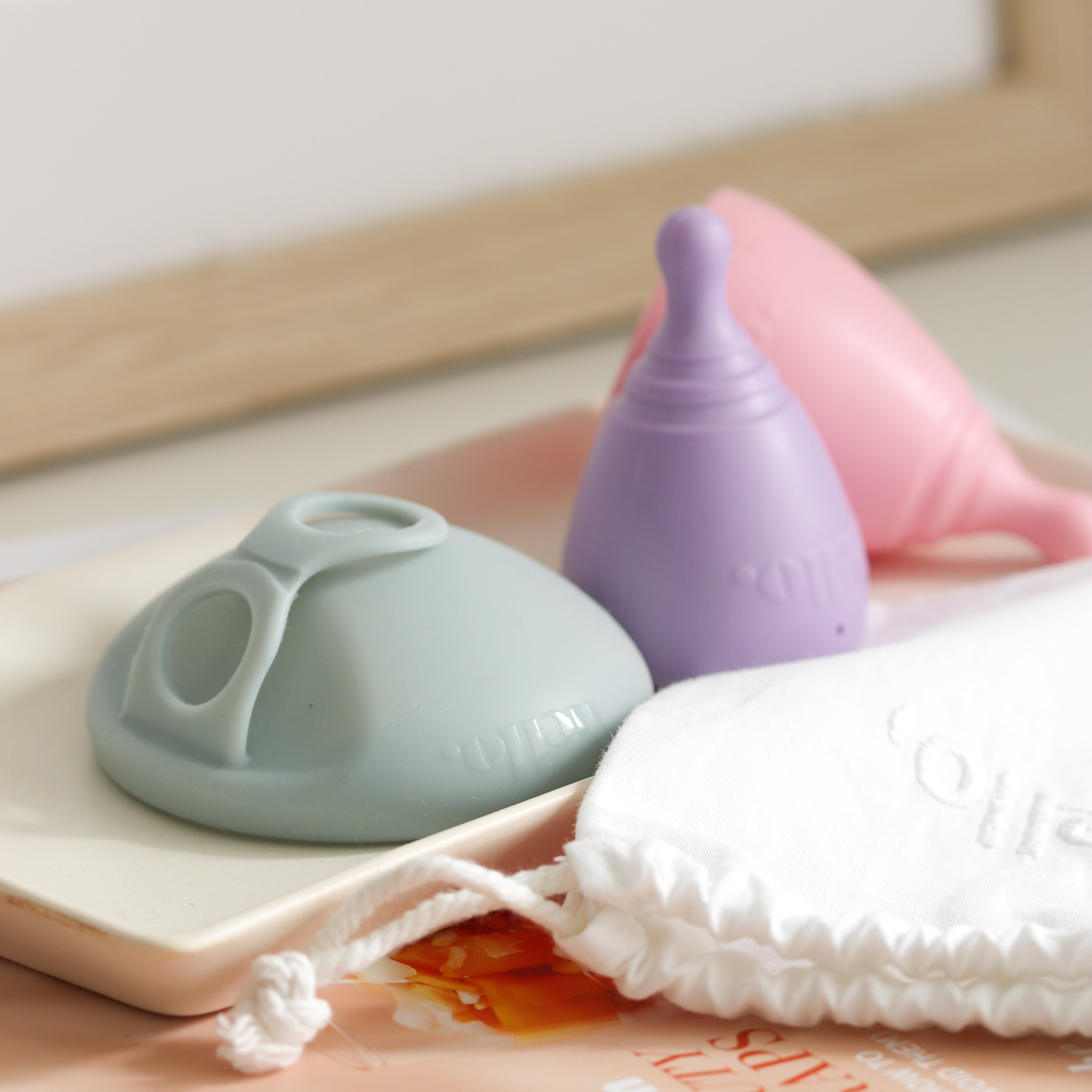
The Hello Cup is made from medical-grade thermoplastic elastomer rather than silicone. It is designed to mould comfortably to the body while maintaining enough spring to open and form a reliable seal.
Where Does a Menstrual Disc Sit?
Higher, beneath the cervix
A menstrual disc is pinched into a narrow shape, guided back and down towards the tailbone, and then tucked behind the pubic bone.
Rather than sitting vertically in the vaginal canal, it rests at an angle beneath the cervix. The cervix sits above the collection basin, allowing menstrual fluid to flow directly into the disc.
A disc does not rely on the same type of seal as a cup. Its fit depends more heavily on the relationship between the disc’s diameter and your internal anatomy.
Because it sits higher, away from the vaginal opening, many people find a well-fitted disc exceptionally comfortable. It can be a good option for anyone who has tried a cup but dislikes the sensation of pressure lower in the vaginal canal.
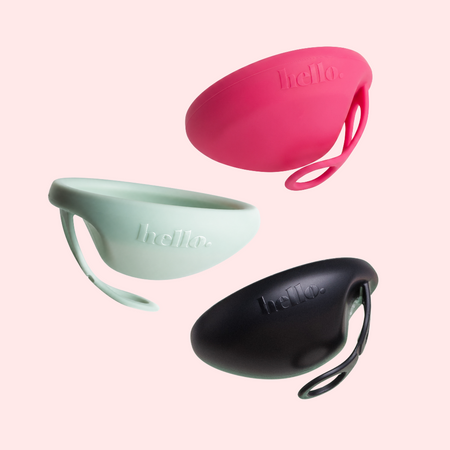
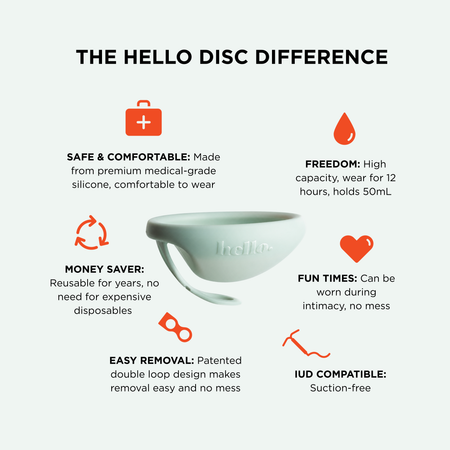
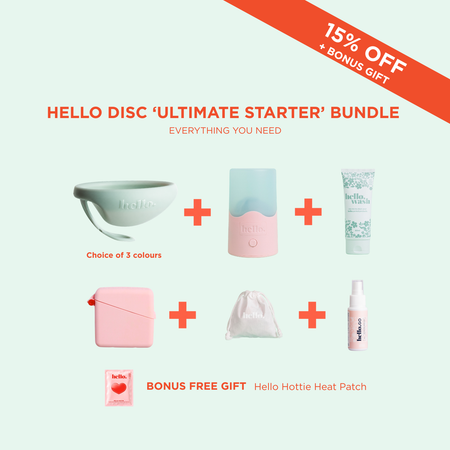
Hello Disc has a soft, flexible basin and a supportive rim designed to stay tucked behind the pubic bone. Its patented double-loop removal tabs also give you something easy to find when it is time to take the disc out because blind fishing expeditions are not our idea of a good time.
Menstrual Cup vs Disc Capacity: Which Holds More?
For people with a heavy period, capacity can make a big difference.
A laboratory study published in BMJ Sexual & Reproductive Health tested the capacity of 21 modern menstrual products using red blood cells. Of the product categories tested, menstrual discs held the most on average, with an average capacity of 61 mL. The individual menstrual cups tested held between approximately 20 and 50 mL. (srh.bmj.com)
That does not mean every menstrual disc holds exactly 61 mL, or that every disc will provide more usable capacity for every body. The amount a disc can practically hold may depend on how it sits inside you and whether its basin becomes compressed.
Still, discs are generally an excellent option for:
-
Heavy-flow days
-
Overnight use
-
Long workdays
-
Travel
-
People who cannot easily access a bathroom
-
Anyone who would rather empty their product less frequently
A cup may hold less than some discs, but its structured shape makes the capacity easier to predict. Once it has opened and sealed correctly, the collection area remains relatively consistent.
The capacity winner
On paper, the menstrual disc wins.
In real life, the most useful product is the one that fits your body properly and does not leak. A perfectly fitted cup will always beat a poorly fitted disc and vice versa.
Which Is Easier to Remove?
This one is very personal.
Removing a menstrual cup
To remove a cup, you need to release the seal before pulling it out.
Gently pinch or press the base of the cup, wiggle it lower and keep it relatively upright as you remove it. You should not pull a cup out using its tab alone without first releasing the seal.
Because the fluid sits inside a bell-shaped container, removal can feel fairly controlled once you have the technique sorted.
Removing a menstrual disc
With a traditional disc, you usually hook a finger underneath the front rim and carefully draw it out while keeping it as level as possible.
There can be a little more potential for mess because a disc has a shallow basin rather than a deep, structured cup. Technique helps enormously, as does removing it over the toilet or in the shower while you are learning.
Hello Disc was specifically designed to make this step easier. Its double-loop tabs offer multiple removal options:
-
Use the first loop for a short removal tab.
-
Use the second loop for extra reach.
-
Flip the loops to create a streamlined tab.
-
Trim the loops if you prefer a tab-free disc.
No hooking behind the rim. No wondering whether your disc has moved to another postcode.
What Is Menstrual Disc Auto-Dumping?
Auto-dumping—also called self-emptying—is something that can happen with a menstrual disc when you use the toilet.
As you sit down to empty your bladder, your pelvic floor relaxes. That change in pressure and muscle position can allow the front of the disc to shift temporarily, releasing some of the collected fluid into the toilet.
Once you stand up and your muscles return to their usual position, the disc may tuck back into place.
Auto-dumping does not happen for everyone, and it is not a special feature built into one particular type of disc. It is simply something that can occur when a disc’s fit and your anatomy work together in a certain way. (Hello Period)
It also should not happen while you are casually wandering around the supermarket. Your pelvic floor and body position are different when you are sitting on the toilet and actively emptying your bladder or bowel.
After auto-dumping, it is a good idea to check that the front of your disc is still tucked securely behind your pubic bone.
Cups do not auto-dump because their contents are held inside the cup by its seal and upright shape.
Can You Use a Menstrual Cup or Disc With an IUD?
You may be able to use either product with an IUD, but this is one area where getting personalised advice from your doctor, nurse or sexual health provider is important.
A 2023 systematic review found a possible association between menstrual cup use and IUD expulsion. However, the researchers emphasised that the available evidence was limited and that better-quality studies were needed. (PubMed)
A later study published in 2024 found that the relationship may differ depending on the type of copper IUD being used. It also identified accidental IUD self-removal as a possible concern for some menstrual cup users. (PubMed)
Possible causes include:
-
Pulling the cup down without fully releasing its seal
-
Catching the IUD strings during removal
-
Pinching the strings between the cup and vaginal wall
-
The IUD already being in the process of expelling
A disc does not create the same type of seal as a cup, so some IUD users prefer it. However, it would be inaccurate to say that a disc eliminates all possibility of disturbing an IUD. It is still an internal product used near the cervix and IUD strings.
New Zealand sexual-health guidance notes that menstrual discs can be worn with an IUD, but you should still use care and follow professional advice. (Sexual Wellbeing Aotearoa)
Before using either a cup or disc with an IUD:
-
Ask your healthcare provider whether it is suitable for you.
-
Consider waiting until your IUD has settled following insertion.
-
Learn where your strings normally sit.
-
Always release a cup’s seal before removal.
-
Avoid gripping or pulling the IUD strings.
-
Seek medical advice if the strings suddenly feel longer or shorter, you can feel the IUD itself, or you develop unusual pain or bleeding.
Menstrual Cups, Discs and Period Sex
Can you have sex with a menstrual cup in?
A traditional menstrual cup should be removed before penetrative vaginal sex. It sits inside the vaginal canal, where it takes up space and could be uncomfortable for you or your partner.
Can you have sex with a menstrual disc in?
A menstrual disc can generally be worn during penetrative vaginal sex because it sits high beneath the cervix, leaving most of the vaginal canal open.
Some people find that it significantly reduces mess, but “mess-free” is not a cast-iron promise. Bodies move, flow varies and no menstrual product is completely leakproof in every possible situation.
You or your partner may occasionally feel the rim or tabs, particularly in certain positions. That does not necessarily mean the disc is inserted incorrectly.
It is also important to know that a menstrual disc is not contraception and does not protect against sexually transmitted infections. New Zealand guidance notes that a disc could potentially interfere with or tear a condom, so consider your contraception and STI-protection needs before using the two together. (Sexual Wellbeing Aotearoa)
Exercise, Swimming and Overnight Wear
Both menstrual cups and discs are brilliant options for active days.
When fitted and inserted correctly, they can be worn for:
-
Running
-
Swimming
-
Yoga
-
Strength training
-
Hiking
-
Cycling
-
Team sports
-
Sleeping
Because they are worn internally, there is no bulky pad to move around and no tampon string making an unwanted poolside appearance.
A disc may appeal to people who want maximum capacity or dislike feeling pressure in the lower vaginal canal.
A cup may appeal to those who feel reassured by a firm seal and prefer a structured container when it is time to empty their product.
Both Hello Cup and Hello Disc can be worn for up to 12 hours, depending on your flow. On heavier days, you may need to empty yours more frequently. Always follow the product instructions and never exceed the recommended wear time.
Research into menstrual cups has generally found them to be a safe period-management option when they are used and cared for correctly. (The Lancet)
Toxic shock syndrome is extremely rare, but it is not accurate to say that cups or discs carry zero risk. Cases associated with menstrual cup use have been reported. Correct cleaning, handwashing and wear time remain important. (PMC)
Cost and Environmental Impact
Reusable period products require a larger upfront spend than a box of tampons, but they can be far cheaper over time.
A major systematic review published in The Lancet Public Health estimated that, over several years, a menstrual cup could cost only a small fraction of the cost of using disposable pads or tampons. The exact saving depends on product prices, how many disposables you normally use and how long your reusable product lasts. (The Lancet)
The environmental case is strong too.
A comparative life-cycle assessment found that menstrual cups had the lowest environmental impact across the menstrual-product categories and countries studied. Their overall impact score was approximately 99% lower than that of non-organic disposable tampons in the study’s model. (ScienceDirect)
That specific research assessed menstrual cups rather than reusable discs, so we would not simply paste the same percentage onto every reusable product. However, the basic principle is fairly clear: a reusable product used for years replaces a considerable number of individually wrapped disposable products.
One Hello Cup or Hello Disc can be used cycle after cycle for years with proper care. That means fewer emergency tampon runs, fewer bathroom-bin contributions and less money disappearing from your account every month.
A quieter period cupboard and a quieter landfill. We love to see it.
Menstrual Cup vs Disc: Quick Comparison
| Feature | Menstrual Cup | Menstrual Disc |
|---|---|---|
| Shape | Bell-shaped | Flat, round rim with basin |
| Placement | Vaginal canal, below the cervix | Vaginal fornix, beneath the cervix |
| How it stays in place | Gentle seal against vaginal walls | Tucks behind the pubic bone |
| Typical capacity | Varies; tested products commonly held around 20–50 mL | Discs had the highest average tested capacity at 61 mL |
| Wear time | Up to 12 hours, depending on flow | Up to 12 hours, depending on flow |
| Auto-dumping | No | Possible for some users |
| Penetrative period sex | Remove first | Generally possible |
| Swimming and exercise | Yes | Yes |
| IUD considerations | Discuss with your healthcare provider and release the seal carefully | Discuss with your healthcare provider and avoid catching the strings |
| Removal style | Pinch base, release seal and remove upright | Pull rim or removal tab forward |
| Best suited to | People who like a secure seal and structured shape | People wanting high capacity, high placement or period-sex compatibility |
Which Should You Choose?
Choose a menstrual cup if:
-
You like the idea of a secure, seal-based fit.
-
You prefer a deeper, structured container for removal.
-
You find it easier to reach a product sitting lower in the vaginal canal.
-
You do not need a product that can stay in during penetrative sex.
-
You have used cups before and already know they work well for you.
Choose a menstrual disc if:
-
You have a heavy flow or want plenty of capacity.
-
You have found cups uncomfortable or too noticeable.
-
You want a product that sits higher in the body.
-
You would like the option of penetrative period sex.
-
Auto-dumping sounds helpful on heavy days.
- You have an IUD
-
You want easy removal using Hello Disc’s double-loop tabs.
Can I choose both?
Absolutely! Plenty of people keep both a cup and a disc on hand. You might prefer a cup for everyday wear but switch to a disc overnight, on heavy days or when period sex is potentially on the agenda.
There is no rule saying you must commit to one reusable product for the rest of your menstruating life.
Your period. Your body. Your call.
MEET YOUR REUSABLE MATCH
Hello Cup gives you reliable, seal-based protection in a comfortable, flexible cup.
Hello Disc sits higher, offers generous capacity and features our patented double-loop tabs for refreshingly straightforward removal.
Both are reusable, award-winning and made for up to 12 hours of wear—because your period product should fit around your life, not the other way around.
Frequently Asked Questions
Is a menstrual disc better than a menstrual cup?
Not universally. A disc may be better for high capacity, penetrative period sex and people who dislike the lower placement of a cup. A cup may be better for people who prefer a seal-based fit and a structured container that feels controlled during removal.
Which is better for beginners: a menstrual cup or disc?
Both have a learning curve. Some beginners find cups easier to understand because the shape feels familiar and removal is relatively contained. Others find discs easier because they do not need to check that a cup has fully opened and formed a seal.
Which is better for a heavy period?
Menstrual discs generally offer greater capacity. In one laboratory study, discs had the highest average capacity of all product categories tested. (srh.bmj.com)
However, fit matters. The best heavy-flow product is one that sits securely in your body and is emptied often enough for your individual flow.
Can I pee with a menstrual cup or disc inserted?
Yes. Urine leaves the body through the urethra, while menstrual cups and discs are inserted into the vagina.
A disc may release some menstrual fluid while you urinate if you experience auto-dumping. A cup should remain sealed.
Can a partner feel a menstrual disc?
They may not feel it at all, or they may occasionally notice the rim or removal tab. This depends on your anatomy, your partner’s anatomy, the disc and the position.
Can a menstrual disc get lost?
No. The vagina is a closed canal, and the cervix prevents a disc from travelling into the uterus or elsewhere in the body.
It may sit higher than expected or feel difficult to reach if your muscles are tense. Take a break, breathe, squat down and bear down gently to bring it closer.
Can I use a menstrual cup or disc overnight?
Yes. Hello Cup and Hello Disc can be worn for up to 12 hours, making them suitable for overnight use. Empty yours sooner if your flow requires it.
How long does it take to learn to use a cup or disc?
Some people get it on the first try. Others need a few periods to become completely confident.
A large systematic review found that familiarity with menstrual cups generally improved over several cycles and that continued support and practice were important for successful use. (The Lancet)
Be patient with yourself. Nobody emerges from the womb knowing how to tuck a menstrual disc behind their pubic bone.
Are menstrual cups and discs safe?
Research indicates that menstrual cups are generally safe when used correctly, although good hygiene and correct wear time remain essential. Research specifically focused on reusable menstrual discs is more limited, so always follow the manufacturer’s care and use instructions. (The Lancet)
Speak to a healthcare professional if you experience persistent pain, urinary symptoms, unusual discharge, fever or difficulty removing your product.
This article provides general information and is not a substitute for personalised medical advice. Speak to your healthcare provider about internal period products if you have an IUD, have recently had pelvic surgery or given birth, or experience unexplained pelvic pain.