Periods and Exercise: Does Your Menstrual Cycle Really Affect Sports Performance?
If you’ve spent any time down the wellness algorithm of TikTok or Instagram, there’s a good chance someone has told you that your entire exercise routine should be organised around your menstrual cycle.
You might be told to lift heavy during one phase, take it easy during another and then swap running for Pilates next week. Apparently, your ovaries have been quietly moonlighting as personal trainers and you had no idea.
While it’s always important to be mindful of where you are in your cycle, the reality is a lot less simple.
Yes, hormone levels do change throughout the menstrual cycle and plenty of people notice differences in energy, mood, symptoms or simply how exercise feels at different times of the month. For some athletes, those changes can have a very real impact on training and performance, hence why it’s good to know your cycle and where you’re at. But, there’s no one rule (or solid piece of evidence) that supports the suggestion you might be stronger, faster or better at exercise during one particular phase of your cycle.
A 2020 review and meta-analysis of 78 studies found while that exercise performance may be slightly lower during the early follicular phase, which broadly overlaps with the start of menstruation, the average effect was deemed so minor it was classified as ‘trivial’ and researchers recommended an individual rather than one-size-fits-all approach. (PubMed)
More recent research also found mixed results across different types of performance and highlighted issues including small study sizes, inconsistent research methods and limited representation of elite athletes. (PubMed)
So if you’ve ever exercised on day one of your period and thought, I actually feel great today, you’re not doing your cycle wrong but, likewise, if your period arrives with cramps, poor sleep and a general desire to have absolutely nothing to do with a treadmill, you’re not doing it wrong either.
Periods and how they affect us vary hugely from one person to the next. Exercise and performance is also very much individualised and the relationship between the two is much more nuanced than a lot of social media advice would have you believe.
What actually happens during your menstrual cycle?
Before getting into performance, it helps to understand the basic biology.
A menstrual cycle is counted from the first day of one period to the first day of the next. The classic 28-day cycle is useful as a textbook example but real bodies aren’t particularly interested in fitting themselves neatly into textbook diagrams.
Cycles vary between people and can also vary from one month to another.
Broadly speaking, the menstrual cycle is divided into several stages.
Menstruation
Day one of your cycle is the first day of your period. At this point, oestrogen and progesterone are relatively low and the lining of the uterus is being shed.
This is also when symptoms such as cramps, headaches, digestive changes, fatigue or heavy bleeding can show up. For some people, menstruation barely affects their day. For others, symptoms can have a very noticeable impact on how comfortable training feels.
The follicular phase
The follicular phase begins on the first day of menstruation and continues until ovulation. As the cycle progresses, oestrogen generally rises while the body prepares to release an egg.
Ovulation
Ovulation is when an egg is released from an ovary. You’ll often see ovulation described as happening on day 14, but that assumes a very tidy 28-day cycle.
In real life, the timing can vary considerably between people and even between cycles in the same person.
The luteal phase
After ovulation, progesterone rises. If pregnancy doesn’t occur, oestrogen and progesterone eventually fall again and another period begins.
Written down, the whole process sounds like it runs like clockwork but that’s seldom the reality. If you ever have concerns about your cycle and its frequency, length or how much blood you lose, it’s always a good idea to check in with your doctor.
So, does your menstrual cycle affect athletic performance?
Potentially. Without doubt, we need more research - something we find ourselves saying a lot when it comes to women’s health and menstrual cycles! So while we are waiting for more extensive and meaningful research to come out, the one thing we do know is that your cycle may have a genuine impact on your individual performance. There’s also a big difference between the physiological effect of a particular hormonal phase and the very practical impact of menstrual symptoms.
You might not experience a measurable decline in your ability to run, lift, swim or cycle simply because you’re menstruating BUT if you slept badly because of cramps, have a headache, feel bloated and are dealing with a particularly heavy period, it makes perfect sense that your 6am run might feel harder than usual.
Research involving 195 elite athletes preparing for the Tokyo Olympic and Paralympic Games found that around two-thirds perceived their menstrual cycle as affecting performance. Athletes who experienced three or more menstrual symptoms were particularly likely to report feeling affected. (Australian Institute of Sport)
So while those researchers get to work, you might want to move away from asking, “Which menstrual phase is best for exercise?” and instead focus on “How does my cycle affect me?”
Why can exercising on your period feel harder?
Even if your underlying physical capacity hasn’t suddenly dropped, period symptoms can absolutely change how comfortable or appealing exercise feels.
Cramps
Period cramps are caused by uterine contractions and can range from a mild background ache to pain that seriously interferes with everyday activities.
Trying to run intervals while your uterus appears to be staging a small rebellion is understandably not everyone’s idea of an excellent afternoon.
For some people, gentle movement feels helpful. Others find that their usual workout is perfectly manageable. And for people with more severe pain, rest or a modified session may simply make more sense.
Heavy bleeding
Heavy flow doesn’t automatically stop you exercising, but it can create plenty of practical problems.
Leaks are probably the most obvious one. Worrying about leaking through clothing, trying to work out when you’ll get your next bathroom break or needing to change your period product during a long training session can take your focus away from what you’re actually there to do.
For athletes in uniforms, tight clothing or sports such as gymnastics, dance or swimming, that worry can become even more noticeable.
Heavy menstrual bleeding can also contribute to iron deficiency and iron-deficiency anaemia, which is why very heavy periods are worth talking to a healthcare professional about rather than simply escalating to a more absorbent period product and carrying on. (ACOG)
Good period care can make heavy bleeding much easier to manage, but it doesn’t diagnose or treat the reason your bleeding is unusually heavy.
Fatigue
Some people notice they feel more tired around their period.
Sometimes that may be connected to menstrual symptoms, poor sleep or discomfort. There are also plenty of other reasons someone might feel tired, particularly when they are training hard, studying, working, travelling or generally attempting to fit far too much into one week.
If fatigue becomes significant or persistent, particularly alongside very heavy periods, it’s worth getting medical advice rather than simply deciding that periods are supposed to make you exhausted.
Headaches and digestive symptoms
Periods have an annoying habit of involving far more of the body than just the uterus.
Some people experience headaches, nausea, diarrhoea, bloating or other digestive changes around menstruation, all of which can influence how enjoyable exercise feels.
A workout that sounds completely manageable on paper can feel quite different when you’re simultaneously bloated, cramping and wondering whether you should have chosen a route with more bathrooms.
Poor sleep
Pain, heavy bleeding or other menstrual symptoms can also affect sleep.
If you’ve spent half the night waking up uncomfortable or worrying about leaking, the fact that your morning training session feels harder may have as much to do with poor sleep as your menstrual cycle itself.
None of this means you have suddenly become less fit. It’s important to give yourself a bit of slack when your period impacts things such as sleep.
Can exercise actually help period symptoms?
For some people, yes. Physical activity may help reduce menstrual pain, although the type and intensity of exercise that feels good will vary enormously between individuals.
That also doesn’t mean the only exercise that “counts” is an intense gym session.
Movement might mean going for a walk, swimming a few easy laps, cycling, stretching, doing Pilates or yoga, lifting weights, dancing, jogging, playing team sport or continuing with your regular training programme.
The most useful type of movement is usually the one that feels manageable and suits your body that day.
If exercise makes you feel better, fantastic but if your symptoms are significant and resting feels better, that’s fine too.
There’s no medal for completing a workout when you feel dreadful and have cramps. Sometimes an afternoon on the couch might be exactly what your body needs.
Should you cycle-sync your training?
Honestly, while there are people who do this, again the jury is out because there’s not enough research to suggest there’s any merit or advantage to cycle-syncing your training.
Cycle syncing is often presented as the idea that everyone should change their diet, exercise or lifestyle according to particular phases of the menstrual cycle. As we said earlier, there’s definitely advantages to knowing the patterns and nuances of your own cycle but don’t get too caught up in what someone on TikTok says you should do. You know your body best.
There is much less evidence for following a universal training prescription purely because an app says you have entered a particular menstrual phase.
That doesn’t make tracking your cycle pointless.Tracking can help you notice things like, I regularly get strong cramps on the first day of my period, so I’m going to leave a little flexibility in my training schedule around then.
Try tracking symptoms rather than obsessing over phases
If you’re interested in seeing whether your menstrual cycle affects your exercise, you don’t need to turn it into another major administrative project.
For a couple of cycles, keep a rough record of when your period starts and how heavy your bleeding is, along with anything particularly noticeable such as cramps, mood, sleep or energy levels.
You can then add a few notes about your training. What kind of session did you do? How difficult did it feel? Did you feel strong and energetic, completely flat or somewhere in between? How well did you recover?
That gives you something much more useful than a generic menstrual-cycle chart because it is information about your actual body.
You might discover a consistent pattern. Maybe you often feel brilliant at a certain point in your cycle, or you tend to find the first day of your period harder.
You might also discover that there really isn’t much of a pattern at all.
For competitive athletes, tracking also creates a baseline that can make meaningful changes easier to spot, particularly if periods suddenly become very irregular or disappear.
What if my periods disappear when I train hard?
This is one area where sport has historically been far too comfortable with the idea that a missing period simply means someone is training exceptionally hard.
Periods can stop or become irregular for a number of reasons, and those changes deserve appropriate medical advice rather than an automatic assumption about fitness.
One factor that is particularly relevant to sport is ‘low energy availability’. This happens when there isn’t enough energy coming in through food to support both the demands of training and all the normal physiological functions your body needs to maintain.
Low energy availability is central to Relative Energy Deficiency in Sport, or RED-S.
The International Olympic Committee’s RED-S consensus statement recognises menstrual and reproductive disturbances among the potential health consequences associated with problematic low energy availability. (British Journal of Sports Medicine)
So while you definitely don’t need to become obsessed with tracking every menstrual detail, a significant or sustained change in your normal cycle is useful information and something you can share with your doctor if you need extra advice or support.
If your periods disappear unexpectedly or become persistently very irregular, particularly alongside an increase in training or changes in eating, it’s important that you talk to an appropriately qualified healthcare professional.
What are the best period products for exercise?
The best period product for exercise is one that is comfortable, reliable and lets you get on with exercising without spending the whole time thinking about your period.
Some people love internal period products because they barely have to think about them once they’re in place. Others strongly prefer period underwear or pads. Plenty of people combine products, particularly on heavier days.
Your flow, sport, clothing and personal preference will all influence what works best.
Menstrual discs for exercise
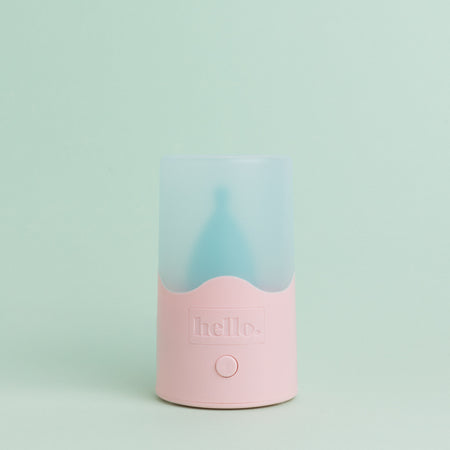
For people who are comfortable with internal period care, menstrual discs can be a really practical option for active days.
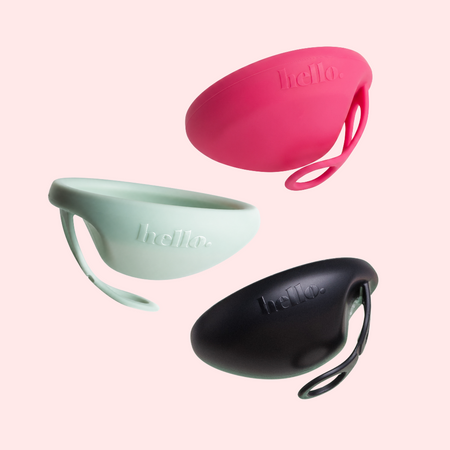
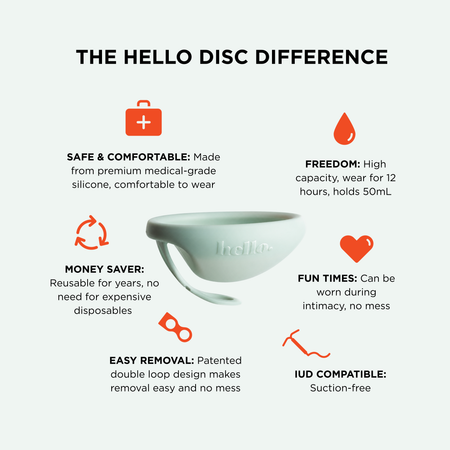
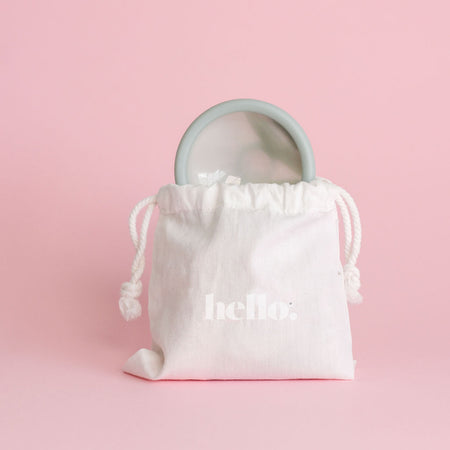
Hello Disc can be worn for up to 12 hours and is suitable for exercise and swimming. It sits higher in the vaginal canal than a menstrual cup and includes Hello’s patented double-loop removal tab to make removal easier. (Hello Period)
With a capacity of up to 50 mL, it can also be useful for longer training days and heavier flows when you’d rather not stop repeatedly to change period products. (Hello Period)
Period underwear for sport
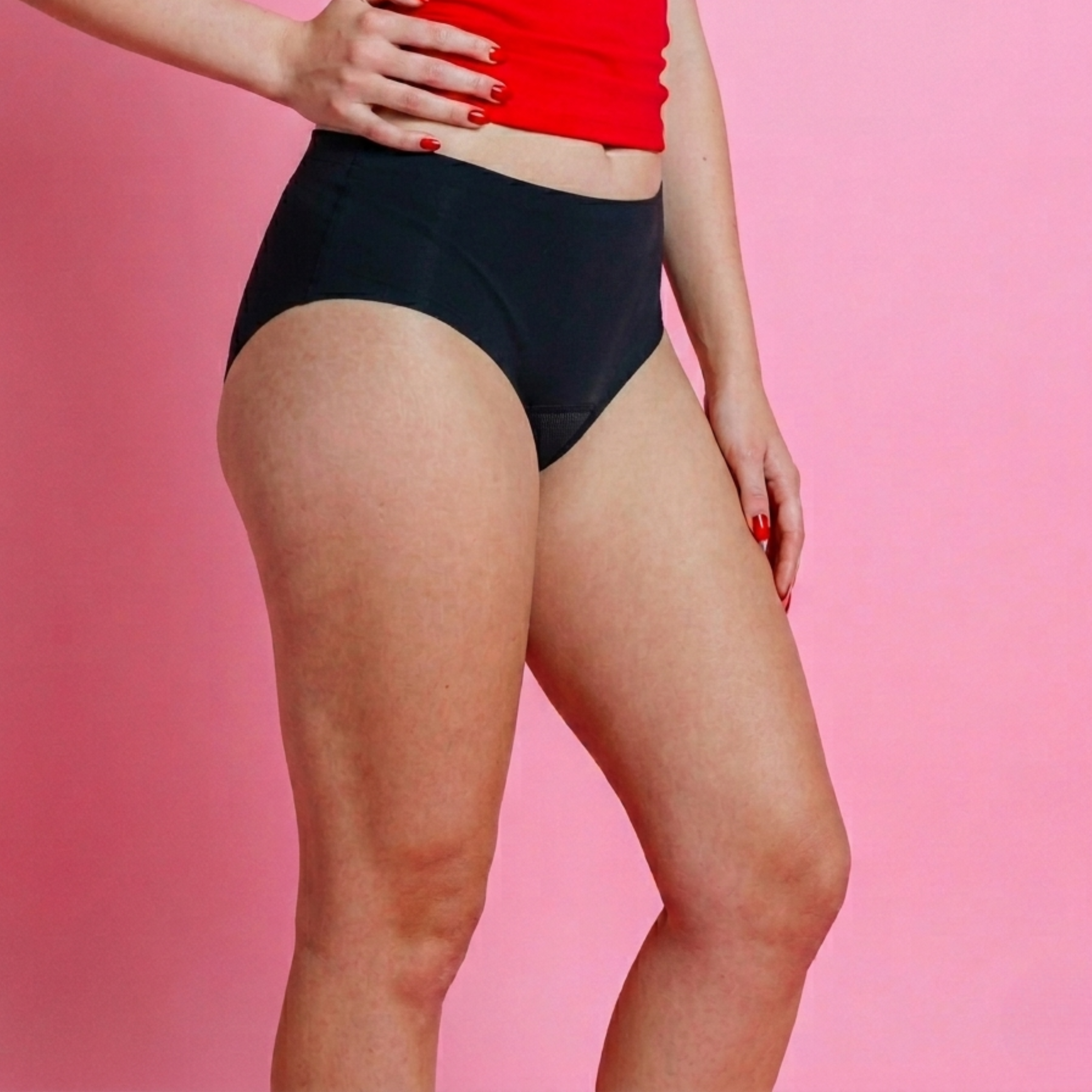
Period underwear is another very useful option because it can be worn alone or as backup with a menstrual cup or disc.
The Hello Undies range includes different levels of absorbency depending on what you need. The Sweet Cheeks thong holds 10 mL, making it suited to lighter flow or backup, while the Best in Show boxer holds up to 50 mL for people who want much higher-capacity protection. (Hello Period)
For gym leggings, bike shorts or other fitted clothing, the seamless Sweet Cheeks period thong is particularly handy on lighter days or as backup when you don’t want a visible underwear line. (Hello Period)
Reusable pads for exercise
If you prefer external period care, reusable pads are another option.
When you’re moving around, the important things are comfort and security. You want a pad that stays where it is supposed to rather than gradually attempting to migrate somewhere else halfway through your workout.
Hello reusable pads use adjustable dome fasteners and silicone grip underneath to help keep them securely in place, along with quick-wick fabric designed to move moisture away from the surface. (Hello Period)
Swimming on your period
Having your period doesn’t mean swimming is off the table.
Internal period products such as menstrual discs and cups are popular options because they can be worn in the water.
Period swimwear can work too. Hello’s The One swimsuit has built-in absorbent and waterproof layers and is designed for light-to-medium flow. (Hello Period)
Ultimately, the best choice is the combination that works for your flow, body, sport and confidence.
Your period isn’t an instruction to stop moving
For a long time, periods in sport seemed to get treated in one of two equally unhelpful ways.
Either periods were framed as a weakness that athletes should avoid mentioning, or people were expected to insist that menstruation never affected anything at all.
Yes, your menstrual cycle is part of your physiology but that doesn’t mean it dictates exactly how you will perform every day of the month. It might affect your experience of exercise significantly and on the other hand, it might barely affect you at all.
With no valid evidence that says people will automatically perform dramatically better or worse during one particular menstrual-cycle phase, the best approach is to learn what works for you as an individual.
Pay attention to how you feel - notice recurring symptoms and don’t be afraid to adjust your schedule if you need to. Choose period products that allow you to move confidently and get medical advice if pain, heavy bleeding, missing periods or other symptoms are interfering with your life.
Medical note: This article provides general educational information and isn’t a substitute for individual medical advice. Speak with a qualified healthcare professional if you have concerns about severe period pain, unusually heavy bleeding, missing or irregular periods, RED-S, iron deficiency or other menstrual-health symptoms.